
Many newcomers seeing XLM for the first time typically have two reactions.
The first: "Isn't this an old coin from the last bull run?" The second: "Isn't it basically the same as XRP?"
Both questions are natural. Over the past few years, crypto market attention has been absorbed by BTC ETFs, the Solana ecosystem, AI coins, Meme coins, RWA, and new DeFi narratives. XLM doesn't look like a "hot asset."
But if you only understand XLM as an "old coin," you'll miss its real value logic.
The Stellar network behind XLM was never intended to be the "next Ethereum" or "digital gold." What it truly aims to solve is a more specific, real-world problem:
Global cross-border remittances are too slow, too expensive, and too unfair — can blockchain bring the cost down?
This is where XLM differs from most altcoins.
Many projects talk about "future potential applications." Stellar talks about "already existing payment and remittance demand in the real world."
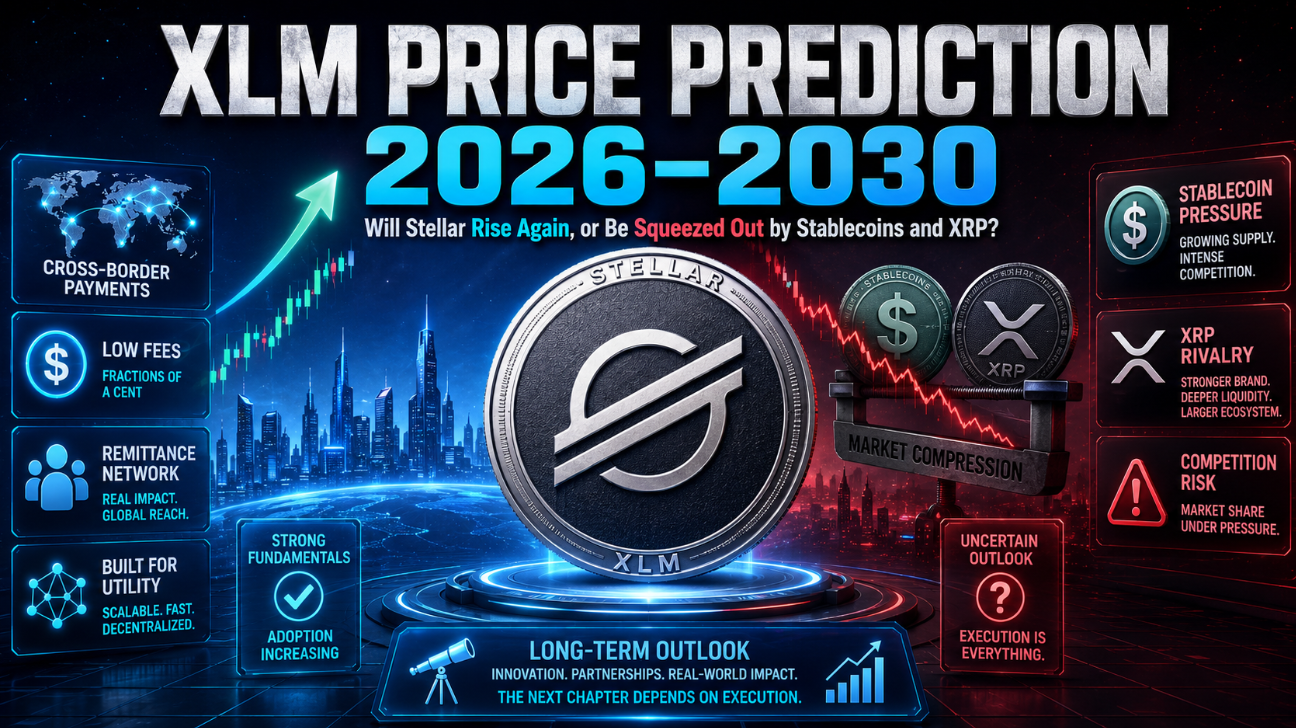
As of now, CoinMarketCap data shows XLM trading around $0.16, with a circulating supply of approximately 33.49 billion, a maximum supply of about 50 billion, and a market cap of roughly $5.4 billion. This size means XLM is no longer a small-cap speculative coin, but it's still far from its all-time high.
The core question this article aims to answer:
Between 2026 and 2030, does XLM still have a chance to be re-priced by the market?
1. Why does XLM deserve serious attention again in 2026?
Many people think XLM is "outdated," mainly for three reasons.
First, XLM had strong runs in 2017 and 2021, but has performed poorly for long periods since. Second, the cross-border payment narrative has been fragmented by XRP, stablecoins, CBDCs, and exchange internal transfers. Third, the Stellar ecosystem doesn't have as many popular DeFi and Meme applications as Solana or Ethereum.
However, these issues do not simply mean "XLM has no value."
XLM is truly worth re-examining because three structural opportunities may emerge in 2026–2030.
1. Stablecoin regulation enters a compliance phase
Stablecoins are transforming from "crypto tools" into "global payment infrastructure." Once stablecoins become compliant, the real problem to solve is no longer "do we have USD stablecoins," but:
How can stablecoins flow globally at low cost?
Stellar happens to be a network optimized for payments and asset transfer. Stellar's official materials emphasize that its network is suited for building financial products and services, supporting low fees, fast transactions, and scalable payment scenarios.
2. Real-world partnerships like MoneyGram continue to advance
Stellar isn't a project that exists only in a whitepaper. In April 2026, MoneyGram and Stellar announced an extension of their partnership to continue expanding real-world stablecoin applications globally.
This matters for XLM.
Because many public chains talk about "potential future institutional adoption," while Stellar already has real-world collaboration foundations in cross-border payments and cash on/off ramps.
3. Soroban smart contracts make Stellar more than just a payment chain
In March 2024, Stellar smart contracts went live, accompanied by a $100 million Soroban Adoption Fund to drive ecosystem development.
This means Stellar is no longer just a transfer network — it's also beginning to gain the ability to build DeFi, payment applications, RWA applications, and on-chain financial products.
Of course, Soroban is still far from the mature ecosystems of Ethereum or Solana. But it at least gives XLM an additional growth curve.
Core conclusion: XLM hasn't suddenly become a hot new coin; rather, several trends — stablecoins, compliant payments, cross-border remittances, and smart contracts — are converging again.
2. What exactly is XLM? Explained in one sentence.
XLM is the native asset of the Stellar network.
If you had to explain Stellar in one sentence:
Stellar aims to be a global low-cost cross-border payment network, serving especially those people and institutions underserved by the banking system.
Traditional cross-border remittances typically have three pain points:
- Slow speed.
- High fees.
- Many intermediaries.
Stellar's official introduction notes that traditional cross-border transfers can often take 3–5 days and incur high fees, whereas the Stellar network supports low-cost, fast cross-border payments targeting 180+ countries and regions.
This is the most fundamental difference between Stellar and typical public chains.
- Ethereum solves the "open smart contract platform."
- Solana solves "high-performance on-chain applications."
- Bitcoin solves "decentralized store of value."
- Stellar solves "global payments and asset transfer."
XLM's roles in the network are primarily three:
- Network transaction fees — Operations on Stellar require extremely low fees. Public information shows base transaction fees can be as low as 0.00001 XLM, making it suitable for micropayments.
- Spam prevention — Accounts must maintain a minimum XLM balance, preventing spam accounts and transactions.
- Asset bridging and liquidity — Within the Stellar ecosystem, XLM can serve as a bridge liquidity tool between different assets, facilitating asset exchange and payment pathfinding.
However, investors must understand one point:
XLM is not a stablecoin. Its price fluctuates, so it may not be the ultimate payment asset, but it can serve as a base asset and liquidity asset within the payment network.
3. What are the differences between XLM and XRP?
XLM and XRP are often compared — that's normal.
Both are related to cross-border payments and emphasize fast, low-cost transfers. But their organizational structures, market positioning, and regulatory narratives differ.
XRP is more like an enterprise-grade cross-border settlement asset
Ripple, the company behind XRP, emphasizes financial institutions, banks, corporate payment solutions, and on-demand liquidity.
Its advantage is stronger commercialization ability and more proactive institutional outreach.
The downside: XRP has long been affected by US regulatory lawsuits, and while uncertainty has decreased, the "corporate operation" label remains evident.
XLM is more like an open public payment network
The Stellar Development Foundation (SDF) is a non-profit organization. SDF's official mandate page explains that since 2014, SDF has been authorized to use XLM to support Stellar and broader ecosystem development.
This gives XLM a narrative leaning toward "public network" and "financial inclusion" rather than "corporate payment product."
But this is a double-edged sword.
A non-profit structure makes Stellar appear more neutral and suitable for public financial infrastructure narratives. However, it also means Stellar lacks the strong commercial sales drive of Ripple.
So the difference can be understood this way:
XRP is more like an asset promoted by a commercial cross-border payment company; XLM is more like a base asset within a public financial network.
This also determines their different investment logics.
4. Five key drivers to understand before predicting XLM
XLM cannot be predicted using Meme coin or DeFi coin logic.
- Meme coins depend on sentiment and spread.
- DeFi coins depend on TVL, revenue, and lock-up.
- Layer 1s depend on developers, applications, and ecosystem capital.
For XLM, the focus should be on:
Real demand for cross-border payments, stablecoin circulation, institutional partnerships, regulatory environment, and competition with XRP.
Driver 1: Will the global cross-border remittance market move on-chain?
XLM's core long-term opportunity comes from cross-border remittances.
Hundreds of millions of users need to send money from one country to another — especially migrant workers, freelancers, cross-border e-commerce merchants, small businesses, and the unbanked.
The traditional remittance system's problems are high cost, slow speed, and complex processes.
If blockchain can reduce cross-border transfers from days to seconds and cut fees from several percent to near zero, this market is ripe for transformation.
But there's a practical issue:
End users may not directly use XLM; they may use USDC, USDT, or local stablecoins.
This is both a challenge and an opportunity for XLM.
Challenge: Stablecoins may take the role of "payment asset." Opportunity: Stablecoins need an underlying network for circulation, and Stellar can become the track for stablecoin payments and transfers.
Thus, XLM's price depends not only on "how many people pay directly with XLM," but on whether the Stellar network becomes critical infrastructure for stablecoin cross-border flows.
Driver 2: Impact of stablecoin compliance on the Stellar ecosystem
The clearer stablecoin regulation becomes, the more payment-focused chains like Stellar stand to benefit.
Why?
Because institutions and payment companies fear compliance uncertainty more than technical issues.
If the US, EU, and major Asian markets establish clearer rules for stablecoin issuance, reserves, auditing, and payment use cases, more financial institutions will dare to integrate stablecoins into cross-border payment systems.
Stellar's advantages include:
- Low fees
- Fast speed
- Payment-optimized design
- Existing partnerships like MoneyGram
- Support for USDC and other asset
- SDF's long-standing emphasis on compliance and financial inclusion
But investors should note: stablecoin compliance does not automatically drive XLM's price higher.
Users might use only USDC without holding XLM. XLM must capture value through fees, minimum balances, liquidity bridging, ecosystem applications, and network growth.
In other words:
Stellar network growth does not necessarily equal proportional XLM price appreciation. The key is XLM's value capture ability within the network.
Driver 3: SDF resource allocation and XLM reserve management
XLM investors must pay attention to SDF.
SDF holds significant resources for ecosystem building, partner support, developer incentives, and network promotion.
This has both benefits and risks.
Benefits: Stellar is not an abandoned old project; SDF continues to drive ecosystem development. Risks: If the market fears SDF unlocking or selling XLM, the price may suffer.
In December 2025, SDF published an update on its mandate, explaining that its resource allocation framework will adjust based on Stellar's actual development after 2025.
Such information is important for investors.
XLM's price is not determined purely by free market circulation; the pace of SDF's ecosystem grants, partnership investments, and reserve usage can all affect market expectations.
The most common mistake newcomers make: reading only partnership news, ignoring supply and capital flows.
Driver 4: Indirect impact of BTC cycles on XLM
XLM is not BTC, but it is still affected by BTC cycles.
Historically, most old altcoins see rotation after BTC strengthens. XLM is no exception.
Typically, XLM's bull market logic is not the earliest mover. It tends to be a late-cycle asset:
- BTC attracts capital first.
- ETH and major Layer 1s rise next.
- DeFi, Meme, and hot narratives rotate.
- Finally, some old coins and payment coins get catch-up gains.
This is why XLM sometimes becomes active suddenly at the end of bull markets.
But such moves are risky.
They may be driven not by fundamentals but by retail FOMO and capital rotation.
So you need to distinguish two types of rallies:
- One driven by Stellar network data growth.
- One driven by late-cycle capital rotation.
The former is healthier. The latter rises fast but falls fast too.
Driver 5: Competitive threats and boundaries
XLM's competition is not a single project but an entire payment ecosystem.
Main competitors include:
- XRP
- Stablecoins like USDC, USDT
- Bitcoin Lightning Network
- Solana Pay
- Stablecoin transfers on Tron
- CBDCs
- Traditional payment companies
- Exchange internal transfer networks
Among these, the strongest threat is not XRP but stablecoins.
Because when ordinary users make cross-border transfers, their main concern is:
If I send $100, does the recipient receive nearly $100 in value?
XLM's price fluctuates; stablecoins do not fluctuate significantly. This makes stablecoins naturally better for payments.
Thus, XLM's future is not to compete with stablecoins but to become part of the stablecoin circulation network.
That is XLM's most realistic path forward.
XLM 2026–2030 Price Prediction Overview
Below is a scenario-based prediction based on current price, historical cycles, Stellar ecosystem development, stablecoin trends, and competition in the payment sector.

This prediction is not a promise of returns, but a valuation extrapolation under different development paths.
5. XLM Price Prediction 2026: The Year Compliance Dividends Launch
2026 is an important window for XLM to regain market attention.
Reasons are clear:
- Stablecoin payments are going mainstream.
- The MoneyGram and Stellar partnership continues to advance.
- After two years of development, the Soroban smart contract ecosystem may begin to see more mature applications.
- If BTC remains at high levels, old payment coins may see capital rotation.
2026 Bullish Logic
If XLM rises in 2026, it will mainly be because the market re-understands the value of a "compliant payment network," not because XLM suddenly becomes a hot public chain.
Stellar is not like some high-risk DeFi projects chasing leveraged yields; it is more like an underlying payment network.
If global stablecoin payment volumes continue to expand, then USDC on Stellar, cash on/off ramps, cross-border remittances, and enterprise payment scenarios could all bring new attention.
2026 Price Range
- Conservative: 0.18–0.30 — BTC market mediocre, XLM only slightly up with the market, no major Stellar ecosystem breakthrough.
- Baseline: 0.30–0.55 — Stablecoin and cross-border payment narratives heat up, XLM strengthens with major payment coins.
- Optimistic: 0.55–0.75 — Major payment partnership implemented, Soroban ecosystem shows growth, XLM approaches previous major resistance zone.
Key Data to Watch in 2026
- Daily Stellar network transaction volume
- USDC circulation on Stellar
- MoneyGram-related usage data
- Number of Soroban ecosystem projects
- Change in XLM active addresses
- XLM trading volume and deposit/withdrawal changes on exchanges like HIBT
If XLM deposit volume increases on platforms like HIBT with rising volume but price not yet moving, it may indicate users are positioning early. Conversely, if price skyrockets without sustained deposits/withdrawals and volume, beware short-term speculation.
Core conclusion: The reasonable baseline range for XLM in 2026 is 0.30–0.55. Breaking $0.75 would require significantly better-than-expected stablecoin compliance and payment partnerships.
6. XLM Price Prediction 2027: Can Real Usage Support the Bottom?
2027 could be a stressful year for XLM.
If the crypto market has already risen in 2026, 2027 is likely to see a pullback or consolidation. Most altcoins will face valuation compression, and XLM will be no exception.
But XLM differs from pure speculative coins in that it has a verifiable bottom logic:
Even if the price falls, does anyone still use the Stellar network?
If network transaction volume, stablecoin circulation, and cross-border partnerships still exist, XLM won't lose all its value foundation.
But if price falls while on-chain activity, partnerships, and developer ecosystem also decline, that signals serious problems.
2027 Price Range
- Conservative: 0.10–0.18 — Bear market, XLM retraces significantly with altcoins.
- Baseline: 0.18–0.35 — Price corrects, but Stellar network real usage remains stable.
- Optimistic: 0.35–0.45 — XLM falls less than average altcoins, supported by stablecoin payments and MoneyGram use cases.
Key Judgement Criteria for 2027
By 2027, investors should not look only at price, but at five indicators:
- Whether Stellar network transaction volume remains stable
- Whether USDC usage on Stellar is growing
- Whether SDF continues to invest in the ecosystem
- Whether Soroban has real applications
- Whether XLM withdrawals and long-term holdings on exchanges like HIBT show unusual changes
If XLM withdrawal volume increases while price continues to fall, there could be two explanations:
- Users are moving XLM out for real payments or cross-border transfers.
- Users are exiting platforms or liquidity is decreasing.
These have very different implications and need to be assessed with on-chain data.
Core conclusion: XLM's price may correct in 2027, but the real question is whether Stellar network's real usage can hold the floor.
7. XLM Price Prediction 2028: Critical Window Before Cross-Border Payment Landscape Locks In
2028 is the most critical year in XLM's long-term prediction.
Because around 2028, the global crypto payment landscape may largely take shape.
Three possible outcomes for the future payment market.
Outcome 1: Stellar becomes one of the compliant cross-border payment networks
This is the ideal scenario for XLM.
If Stellar continues to expand partnerships with MoneyGram, stablecoin issuers, payment companies, wallets, and regional financial institutions, it could become a key underlying network for compliant cross-border payments.
In this case, XLM would gain long-term valuation support.
Outcome 2: XRP and Ripple dominate institutional payments
If Ripple gains a clear lead in bank and institutional payment markets, Stellar could be squeezed into smaller financial inclusion and open payment niches.
In this case, XLM still has value, but its ceiling is lower.
Outcome 3: Stablecoins and CBDCs eat most payment use cases
This is XLM's biggest risk.
If users can complete cross-border payments directly with CBDCs, bank stablecoins, USDC, or USDT without needing the Stellar network, demand for XLM would weaken.
But the real world is rarely a single winner.
More likely is a multi-network coexistence: stablecoins as payment assets, different public chains as payment rails, and traditional financial institutions as on/off ramps.
In such a landscape, Stellar still has a chance.
2028 Price Range
- Conservative: 0.18–0.35 — Slow Stellar growth, XLM squeezed by stablecoins and XRP.
- Baseline: 0.35–0.80 — Stellar maintains cross-border payment niche advantage, slight Soroban growth.
- Optimistic: 0.80–1.20 — Stellar gains major institutional partnership, XLM returns near all-time highs.
HIBT Observation Points
If HIBT supports more Stellar network-related deposits, withdrawals, stablecoin transfers, or payment settlement products in the future, focus on:
- Increasing XLM deposit/withdrawal volume
- Active trading paths involving XLM and USDC
- Whether users in Southeast Asia, Latin America, and Africa increasingly use XLM
- Whether XLM holding periods lengthen
- Whether XLM transitions from speculative coin to payment tool asset
Core conclusion: What determines XLM's medium-to-long-term ceiling in 2028 is not the price chart, but whether it can find an irreplaceable position within the stablecoin payment network.
8. XLM Price Prediction 2029: Can an Old Payment Public Chain Regain Valuation?
By 2029, XLM can no longer rely on "new project imagination" to rise.
The market will ask more realistically:
Does Stellar have real users, real transactions, real partnerships, and real revenue logic?
If the answer is yes, XLM will be re-priced. If no, XLM may remain just an old asset, maintaining liquidity through historical nostalgia.
Three conditions needed for 2029 upside
- Stellar cross-border payment network continues to grow.
- The Soroban smart contract ecosystem sees real financial applications.
- XLM maintains value capture through network fees, minimum balances, and liquidity bridging.
If these three conditions hold, XLM has the opportunity to transform from an "old coin" into a "compliant payment infrastructure asset."
2029 Price Range
- Conservative: 0.25–0.55 — XLM still has liquidity but lacks a strong growth narrative.
- Baseline: 0.55–1.20 — Stellar becomes one of the important networks for stablecoin cross-border payments, XLM valuation recovers.
- Optimistic: 1.20–1.80 — Stellar ecosystem enters mature growth phase, XLM breaks above previous cycle high.
Biggest Risk in 2029
XLM's biggest risk is not a low price, but the market no longer believing it has growth potential.
If by 2029 Stellar still hasn't developed a significant ecosystem of applications or expanded real payment usage, investors will categorize it as a "legacy asset from a past cycle."
Core conclusion: Whether XLM can rise in 2029 depends on whether Stellar can prove it is not an old narrative but a still-growing payment network.
9. XLM Price Prediction 2030: What is the Endgame Value of a Non-Profit Public Chain?
2030 is a test of XLM's long-term value boundaries.
By then, XLM could move toward two completely different outcomes.
Optimistic outcome: Global compliant cross-border payment network
If Stellar becomes an important network for stablecoin payments, cross-border remittances, cash on/off ramps, and financial inclusion applications, XLM could gain long-term valuation support.
It may not become the largest public chain, but it could become a clear, real-demand payment infrastructure.
Pessimistic outcome: Marginalized by CBDCs, stablecoins, and XRP
If CBDC interoperability, bank stablecoins, Ripple's institutional network, and exchange internal channels become fully mature, Stellar could be squeezed into a very small market.
In that case, XLM would still exist, but its price ceiling would be lowered.
2030 Price Range
- Conservative: 0.35–0.80 — XLM remains an old payment coin, but growth is limited.
- Baseline: 0.80–1.80 — Stellar holds a stable position in compliant payments and stablecoin circulation.
- Optimistic: 1.80–3.00 — Stellar becomes one of the global cross-border payment infrastructures, XLM gets long-term revaluation.
Can XLM reach $3 by 2030?
Possible, but very difficult.
With a circulating supply of about 33.5 billion coins, a rough estimate: $3 would correspond to a market cap exceeding $100 billion. This would require XLM not just to ride market waves but to have strong real business support.
To reach $3, at least these conditions would need to be met:
- Global stablecoin payment volumes grow significantly.
- Stellar becomes one of the major payment networks.
- Partnerships like MoneyGram continue to expand.
- Soroban ecosystem develops real financial applications.
- XLM's value capture ability strengthens.
- The market re-embraces the compliant payment narrative.
- No serious regulatory or supply selling pressure.
So $3 is not impossible, but it is a highly optimistic scenario.
Core conclusion: Whether XLM can strengthen long-term depends on whether Stellar can upgrade from an "old payment chain" to a "compliant cross-border payment network in the stablecoin era."
10. How should XLM be positioned in a portfolio?
XLM is not suitable as a core position for most newcomers.
Core positions are better suited for BTC and ETH. XLM is more appropriate as a satellite position in the payment sector.
Conservative investors
Allocate 1%–3% of total crypto portfolio.
These investors simply want exposure to XLM's potential payment narrative recovery without taking excessive risk.
Balanced investors
Allocate 3%–8%.
These investors recognize Stellar's long-term payment logic and are willing to track on-chain data and partnership progress.
Aggressive investors
Can allocate 8%–12%, but not more.
Because although XLM is an old asset, it is still a high-volatility altcoin with long-term growth uncertainty.
11. How should I buy or hold XLM?
1. Do not buy XLM just because it looks "cheap"
Many newcomers see XLM at only a few cents and think it can rise more easily than BTC or ETH.
This is a misunderstanding.
A low price does not mean a cheap market cap. XLM has a large supply, so focus on market cap and growth potential, not the price per coin.
2. Buy in batches, not all at once
A three-stage strategy:
- First batch: After confirming the logic, buy 30% of planned position.
- Second batch: After price pullback or on-chain data improvement, buy another 30%.
- Third batch: After clear growth signals from Stellar ecosystem, buy the remaining 40%.
3. Do not use partnership news as the sole buying reason
XLM has historically risen on partnership news, but many partnerships do not immediately translate into price.
You need to look at:
- Does the partnership generate real transaction volume?
- Are there real users?
- Is there stablecoin flow?
- Is there ongoing data disclosure?
- Does it increase demand for XLM?
4. Use platforms like HIBT to gauge market sentiment
On trading platforms like HIBT, focus on:
- Whether XLM trading volume continues to expand
- Whether order book depth improves
- Whether XLM deposits/withdrawals show anomalies
- Whether XLM and XRP show rotation
- Whether price increases come with real volume
- Whether user interest from Southeast Asia, Africa, Latin America increases
If XLM is only being pumped short-term, volume typically spikes and then quickly fades. If XLM enters a genuine revaluation cycle, volume, number of holders, withdrawal usage, and on-chain activity should all improve together.
12. Conditions under which XLM predictions would fail
Any price prediction has assumptions. If the following occur, this article's predictions need reassessment.
1. Core partnerships like MoneyGram end or switch to other networks
If Stellar loses important real-world partners, the market will reassess its cross-border payment value.
2. Stablecoin payments completely bypass Stellar
If USDC, USDT, and bank stablecoins predominantly circulate on other networks and Stellar fails to capture stablecoin growth dividends, XLM's valuation will suffer.
3. No real applications in Soroban ecosystem
If years after smart contract launch there are still few users and developers, the market will lower expectations for Stellar's second growth curve.
4. SDF
SDF's resource deployment benefits the ecosystem, but if the market perceives excess supply pressure, prices may be impacted.
5. XRP gains overwhelming advantage in institutional payments
If Ripple fully captures institutional cross-border settlement mindshare, XLM's payment narrative may be marginalized.
6. CBDC cross-border systems mature rapidly
If central bank digital currency interoperability is implemented on a large scale, some cross-border payment demand may no longer need open networks like Stellar.
7. Major exchanges reduce XLM liquidity
As an old asset, XLM needs exchange liquidity support. If trading depth declines, price volatility will increase.
FAQ: Common Questions About XLM Price Prediction
1. What is XLM coin?
XLM is the native asset of the Stellar network. Stellar is a blockchain network focused on cross-border payments, stablecoin circulation, and asset transfer, aiming to make global money movement faster and cheaper.
2. What is the difference between XLM and XRP?
XRP leans more toward Ripple's institutional payment and cross-border settlement products. XLM leans more toward an open public payment network, promoted by the non-profit Stellar Development Foundation.
Both focus on cross-border payments, but their organizational structures, ecosystem paths, and market positions differ.
3. Can XLM reach $1 in 2026?
Possible, but not the baseline scenario.
The baseline prediction for 2026 is 0.30–0.55. If stablecoin compliance advances significantly, partnerships like MoneyGram generate clear transaction volume, and the Stellar ecosystem regains market attention, XLM could challenge $0.75 or higher.
$1 would require a stronger market cycle and clearer fundamental breakthroughs.
4. Can XLM reach $3 in 2030?
Theoretically yes, but it's a highly optimistic scenario.
$3 would imply a market cap over $100 billion, requiring Stellar to become a key infrastructure for global stablecoins and cross-border payments.
If Stellar only maintains small-scale usage, it will be very difficult to reach that target.
5. Is XLM suitable for long-term holding?
XLM is suitable for long-term tracking, but not for blindly heavy long-term holding.
If you are bullish on cross-border payments, stablecoin circulation, and compliant financial networks, you can hold XLM as a small satellite position. If you seek higher certainty, BTC and ETH are better as core positions.
6. What is XLM's biggest risk?
XLM's biggest risk is insufficient value capture.
Even if Stellar network usage grows, it does not guarantee XLM price appreciation. Investors need to confirm whether XLM captures sufficient value from fees, minimum balances, liquidity bridging, and ecosystem growth.
7. Is stablecoin development positive or negative for XLM?
Both sides.
If stablecoins circulate heavily on Stellar, it's positive. If stablecoins mainly circulate on Tron, Ethereum, Solana, or bank-exclusive networks while bypassing Stellar, that's negative.
So the key is not whether stablecoins grow, but whether Stellar becomes part of the stablecoin payment network.
8. How important is Soroban to XLM's price?
Soroban is Stellar's smart contract platform. It gives Stellar the ability to build DeFi, RWA, payment applications, and on-chain financial products.
If the Soroban ecosystem develops successfully, XLM's valuation logic will expand from "payment coin" to "payment + application ecosystem." If Soroban develops slowly, its price impact will be limited.
9. Which is better for the payment narrative, XLM or BCH?
BCH leans more toward peer-to-peer cash, emphasizing low-fee on-chain payments. XLM leans more toward a cross-border payment network, emphasizing stablecoins, asset transfer, and institutional partnerships.
If you believe in personal on-chain payments, BCH is more direct. If you believe in compliant cross-border remittances and stablecoin circulation, XLM is more noteworthy.
10. Should a newcomer buy XLM now?
Not a simple yes or no.
Newcomers should first ask themselves three questions:
- Do I understand the differences between XLM, XRP, and stablecoins?
- Can I accept XLM being range-bound or pulling back significantly for long periods?
- Will I regularly track Stellar network data instead of just watching the price?
If you cannot answer these three questions, heavy buying is not recommended.
Risk Warning: Things You Must Know Before Investing in XLM
XLM is a high-volatility crypto asset. This article is for market research and educational sharing only. It does not constitute investment advice, financial advice, legal advice, tax advice, or a recommendation to buy or sell. Crypto asset prices are extremely volatile, and investors may lose some or all of their principal.
1. Price volatility risk
Although XLM is an old asset, it is still an altcoin. It may rise rapidly in bull markets but also fall or trade sideways for extended periods in bear markets.
2. Value capture risk
Stellar network growth does not directly equal XLM price appreciation. If network activity is primarily driven by stablecoins while XLM demand does not increase in tandem, the price may underperform.
3. Competition risk
XLM faces competition from XRP, stablecoin networks, Bitcoin Lightning Network, CBDCs, traditional payment companies, and exchange internal transfer systems.
4. Partnership implementation risk
Stellar's partnership news does not always translate into real transaction volume. Investors should not rely solely on announcements but look at actual usage data.
5. SDF supply management risk
SDF's resource deployment benefits the ecosystem, but if the market fears XLM unlocking or selling pressure, the price may be affected.
6. Regulatory risk
Cross-border payments, stablecoins, and crypto assets are all subject to regulatory changes. If major countries increase restrictions, Stellar's ecosystem and XLM liquidity may be impacted.
7. Technical ecosystem risk
While Soroban smart contracts open new space for Stellar, if developers and users are lacking, ecosystem growth may fall short of expectations.
Final Conclusion: XLM is not a get-rich-quick narrative, but a compliant payment narrative
The most common misunderstanding about XLM is that many people see it as just another old coin.
But XLM's real investment logic is not "the next 100x coin." It is:
Can Stellar become a low-cost, compliant, global cross-border payment network in the stablecoin era?
If the answer is yes, XLM has the opportunity to regain valuation recovery between 2026 and 2030.
Under the baseline prediction:
- 2026: $0.30 – $0.55
- 2027: $0.18 – $0.35
- 2028: $0.35 – $0.80
- 2029: $0.55 – $1.20
- 2030: $0.80 – $1.80
In an optimistic scenario, if Stellar achieves clear breakthroughs in stablecoins, MoneyGram partnerships, Soroban ecosystem, and cross-border payment networks, XLM could challenge 1.80–3.00 by 2030.
But if stablecoins bypass Stellar, XRP dominates institutional payments, Soroban develops slowly, or SDF supply pressure persists, XLM could remain in an undervalued range for a long time.
Therefore, for ordinary investors, XLM is not an asset suitable for blind heavy positions, but rather a "compliant payment sector asset" worth tracking with a small position.
What truly determines XLM's future is not how high it has reached in the past, but whether Stellar can still occupy an irreplaceable position in the future global cross-border payment network.